25 ALBUMS DEEP
A Look Back at Where It All Began
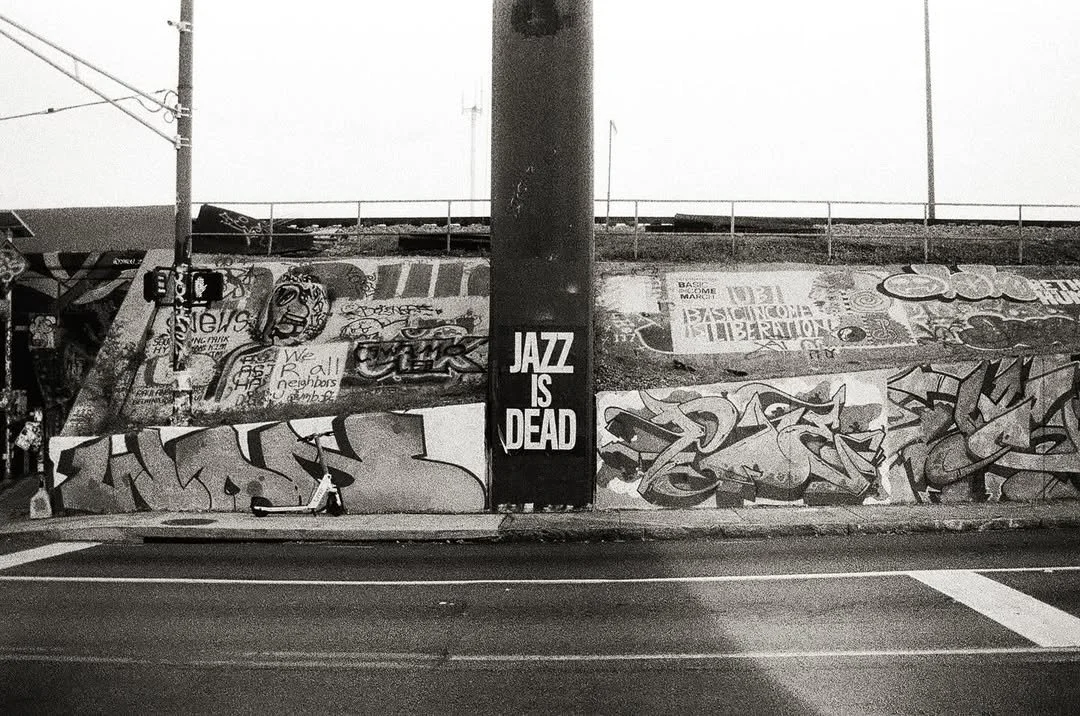
Walking around with a Jazz Is Dead t-shirt is an experience in itself. It's an invitation. It's a magnet for passion, for debate, and for the unlikeliest of connections. You'll be grabbing coffee, and someone will stop you in your tracks. You'll be walking down the street, and a stranger will scream from a passing car, "Jazz is not dead!!!!" with the fervor of a preacher saving a soul.
The fact is, the name does not go unnoticed. It's a conversation starter, a bold thesis statement, and like a classic 70's band, everyone wants to know: Where did that name come from?
To find the origin, we have to rewind to 2017. Andrew Lojero, the promoter behind ArtDontSleep, was deep in the trenches of live music, representing the band The Midnight Hour—the project of Adrian Younge and Ali Shaheed Muhammad. On the other side of the table was Adam Block at Sony Music, who had a vision for a Keyon Harrold concert in Los Angeles. They booked the show. The night before the show was supposed to go on sale, Dru found himself alone with a thought that felt like a powder keg. A phrase that had been floating in the back of his mind emerged: Jazz Is Dead.
He knew exactly what he was holding. As a non-Black, non-musician, Dru had always moved through this world with a tremendous amount of respect for the space. He also knew that jazz was having a moment globally, nothing like what it has become today, but a definite swell from where it had been in the first 15 years of his career as a promoter. This name couldn't just be thrown into the world carelessly.
So he was deliberate. One person at a time. First Eric Herrera. Then his wife. Then Adrian. Then Ali. Then Jazmin Hicks. Then Adam. Each conversation, carefully placed. He wanted to share it in steps, knowing that when it finally hit the streets, there would be no taking it back.

Dru, Ali Shaheed Muhammad, Adrian Younge, Adam Block and Jazmin Hicks
Dru postponed the announcement for a week. He went to work with his designer, Hachim Bahous, and they laid down the tracks. They knew they couldn't just announce this with a flyer online. They needed a street approach, but not their typical one. Something that felt more like the graffiti Dru grew up with: sleeker, smarter, harder to miss, and even harder to remove.
When the posters finally appeared, Los Angeles responded. The city that birthed so much musical history recognized something authentic in these streets. The concert sold out. They had touched a nerve. They had tapped into the fierce loyalty of a community that doesn't just listen to jazz but feels it. From the beginning, Los Angeles wasn't just a backdrop; it was a living, breathing character in this story. A city of migrants, of cross-pollination, where the spirit of innovation has always thrived.
For about a year, a series of concerts under the banner of Jazz Is Dead flourished, building a reputation for curation that was as spiritual as it was intellectual. But the vision was already expanding.
In the summer of 2018, the thought had formulated: What if they brought the legends Dru was booking into the studio with Adrian and Ali? These were the maestros whose vinyl grooves had been sampled and studied by Adrian and Ali throughout their careers in hip hop. This wouldn't just be a production gig; it would be a chance to create with the architects of their own musical DNA. And equally important: it would be a chance to bridge generations, to let young musicians stand shoulder to shoulder with the masters and absorb their wisdom in real time. Jazz Is Dead has always been about giving new music a platform, whether it's created by emerging artists or by legends who have been active for decades.
By November 2018, Dru had curated a Black History Month concert series, and the recordings for what would become Series 1 took place simultaneously with the concerts in February 2019. Titans walked through the doors: Gary Bartz, Brian Jackson, Roy Ayers. And when they found out Doug Carn was in town, they got him in the studio too. All within the month of February 2019. Black History Month indeed!
Then, serendipity stepped in. In March 2019, The Midnight Hour toured Brazil. At SESC in São Paulo, Dru, Adrian, and Ali sat down with Marcos Valle, João Donato, and Azymuth. Dru had a long relationship with Azymuth and Arthur Verocai already, and had been in deep talks with Marcos Valle (though he had never been able to book him). Donato came through their friend Kassin. Conversations were had, mutual respect was exchanged, and the lineup for Series 1 was cemented. (Verocai, while a record was not recorded, would participate in the JEM concert series that July 2019.)
This was the birth of the Jazz Is Dead label.
The path, however, is never a straight line. When the pandemic hit in 2020, the world shut down. Live music, the very heart of the JID origin story, vanished overnight. But the tapes were already rolling. The albums had been recorded. With no stages to play, the releases became our collective lifeline. They gave us a reason to keep moving, a concrete goal in a world gone abstract. The music wasn't just a product; it was survival. It was proof that connection could endure, even in isolation.
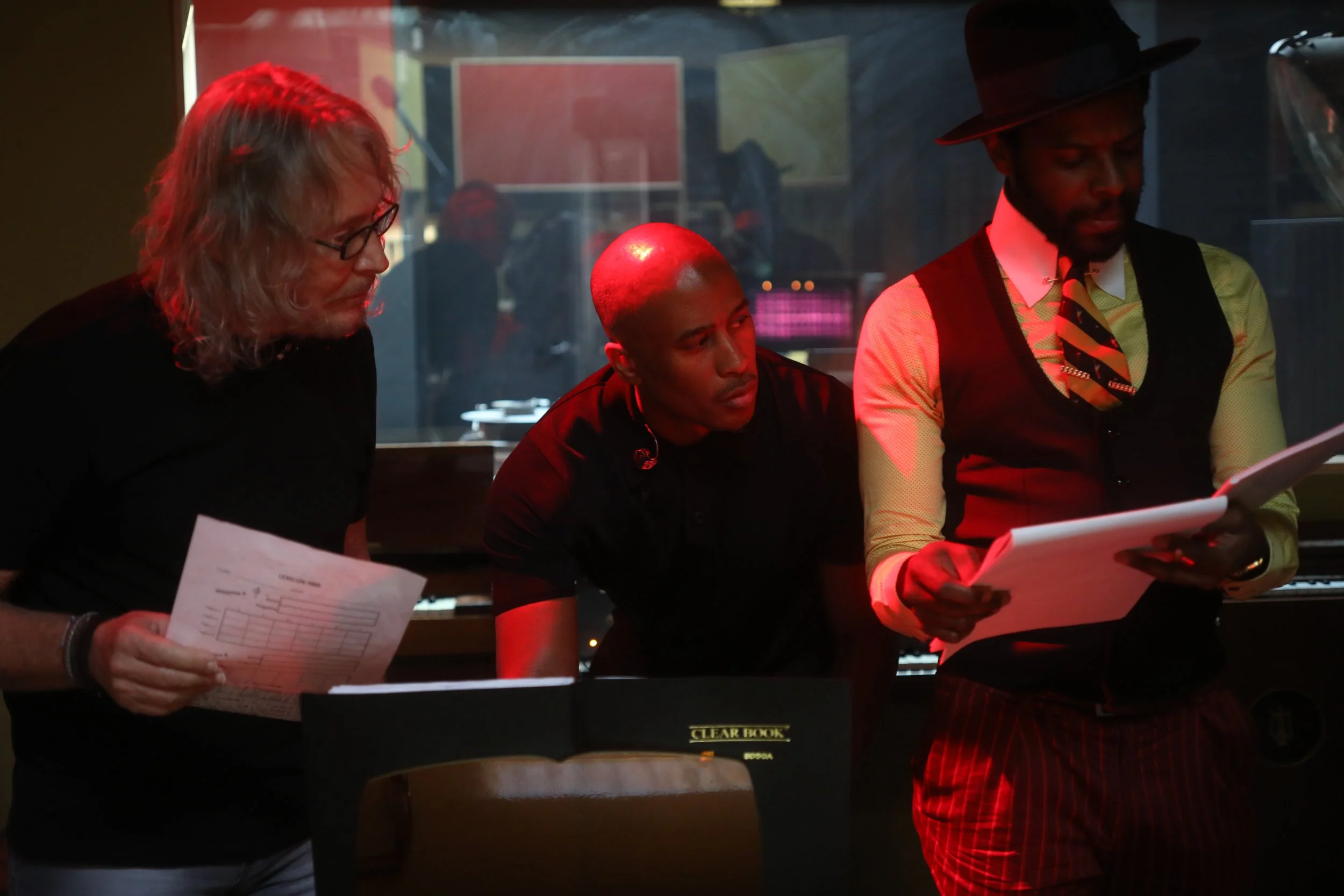
Marcos Valle, Ali Shaheed Muhammad and Adrian Younge in the studio
The rest is history.
The pandemic receded, but the momentum only grew. Series 2 brought a new wave of maestros into the fold: Lonnie Liston Smith, Henry Franklin, Jean Carn, and others. Young artists continued to find their place on the stage alongside these giants, the passing of the torch happening not as a metaphor but as a tangible, musical reality. And now, with Series 3, we find ourselves celebrating a monumental milestone: 25 albums released. We are halfway through the series, celebrating the soulful depths of5 Carlos Dafé JID025, and looking ahead to the magic of Antonio Carlos e Jocafi JID026.
As we look back from JID001 to JID025, one thing remains crystal clear: the core values that started this journey have only deepened. This has never been about mere entertainment. It is about the deep, human connection that happens when people gather to witness greatness. It's about vinyl culture as an active, intentional form of listening: a tangible bond between the artist and the listener. And most importantly, it's about legacy. But not legacy as a museum piece, preserved under glass. Legacy as continuity. These legends aren't here for a curtain call; they are here to show us the way forward. Music is a full contact sport, but likely the only full contact sport that you can age gracefully in. And Los Angeles, with all its complexity and creative friction, remains the home base. The city where the posters first went up, where the community first gathered, and where the spirit of this thing continues to breathe.
So the next time you see someone in a Jazz Is Dead t-shirt, or you yell "Jazz is not dead!" from your car window, know that you are part of the story. You are part of the reaction that proved, from that one solitary night in 2017 when a name was held close and shared with intention, that the spirit of this music is very much full of life.
Here's to 25 albums. Here's to the maestros. Here's to the young lions keeping the flame alive. Here's to the music that refuses to stay silent.